 Alejandro C.
Choosing a reclining chair for office goes far beyond "being able to lean back". If you spend several hours sitting, the chair influences your posture, energy and concentration as much as your screen or lighting. The real goal is twofold: to work with stable support and to be able to take micro-breaks without getting up to find another place.
At Komoder we see it daily: when a client tells us "I want something for my office", there's almost always a reason behind it: neck tension, heavy lower back, tired legs or that mental exhaustion that calls for a reset. That's why in this guide we give you clear tips to get it right according to your use, your space and the type of rest you need.
First define your scenario: intense work, short breaks, or real relaxation
Before looking at models, define what you expect from the chair. A common mistake is buying “the softest one” and discovering that it’s uncomfortable for typing, or the opposite: choosing a rigid chair that doesn’t allow proper work breaks.
I suggest a quick filter: think about whether your chair will be for active work (many hours typing), for 5-10 minute breaks between tasks or for deep rest at the end of the day. From there, your choice changes.
- Active work: prioritize ergonomics, lumbar support and adjustable armrests.
- Short breaks: soft recline, comfortable headrest and leg support.
- Real relaxation: stable footrest, wide recline and, if it suits you, massage.
When you decide based on use, you avoid buying for aesthetics or for a feature that sounds good but that you never use.
Reclining: what matters isn’t “how much,” but *how* it reclines
In an office chair, recline has to feel controlled. If it reclines too easily, it forces you to tense your abdomen and back to stay in place; if it's too stiff, you won't use it. The ideal point is a mechanism that allows you to change posture effortlessly and without noise.
A good tip: look for a reclining mechanism that can be locked in several positions or has adjustable tension. This way you can switch from work mode (more upright) to rest mode (more reclined) without losing support.
- Soft recline (approx. 110–130°): ideal for micro‑rests without fully “disconnecting.”
- Medium recline (approx. 130–150°): useful for relieving lower‑back and shoulder tension.
- Wide recline: best for relaxation, if space allows and the footrest supports it.
If you want a chair for relaxation in your office, the footrest stops being an extra: it’s what turns the recline into a truly restorative posture.
Minimum essential ergonomics (even if the chair is for “relaxation”)
Being reclining doesn’t automatically make it healthy for your back. An office chair needs, at the very least, a backrest that follows your natural curvature and doesn’t push your head forward. If you work on a computer, ergonomics is what prevents the chair from becoming a source of discomfort.
At Komoder we insist a lot on one idea: “soft” comfort without support usually wins on the first day, but loses after two weeks. To choose well, review these key points.
- Lumbar support: better if adjustable or at least well-defined.
- Armrests: adjustable ones help relieve trapezius and shoulder tension.
- Headrest: essential if you're going to recline to rest.
- Seat height and depth: so your legs don't dangle.
A practical tip: when seated, make sure your feet are well supported, your knees aren’t too high, and the backrest holds you without “swallowing” you inward. That’s usually where the real balance between work and rest is found.
Footrest: the difference between “I lean back” and “I recover”
If your goal includes work breaks with a sense of disconnecting, the footrest is the turning point. By elevating your legs, you reduce pressure on the lower back and feel relief in the lumbar area more quickly. That said, not all footrests work the same.
For office use, the most recommended option is a footrest that is stable and easy to activate. If it’s flimsy, too bulky, or difficult to unfold, you’ll end up not using it.
- Retractable: practical if you have little space and want something discreet.
- Robust extendable: better for real relaxation if you’ll use it daily.
- External footrest: a good option if you already have an ergonomic chair and only want to elevate your legs.
If you move a lot during the day, elevating your legs for 5 minutes can give you a surprising sense of physical reset, especially in the mid‑afternoon.
Materials and heat: what you notice during a long workday
In an office, the material matters for two reasons: temperature and maintenance. Synthetic leather can be comfortable and easy to clean, but if your office is warm or you spend many hours sitting, breathability becomes essential. On the other hand, mesh or technical fabric is usually cooler and more stable.
Also think about sound and friction: upholstery that “sticks” when you move or creaks can be annoying. And if you’re on video calls, any detail that makes you constantly readjust affects your presence and comfort.
- Fabric/mesh: cooler, ideal for prolonged use.
- Synthetic leather: easy to clean, executive appearance, but be careful with heat.
- Foam and density: look for enough firmness so you don’t sink into the lumbar area.
If your office is a high‑use space, prioritize a material that withstands daily wear and doesn’t force you to “fight” with the chair to find a comfortable posture.
Size and office layout: measure before you fall in love
A reclining chair needs space to recline… but also to move and work. If the backrest hits the wall or blocks a drawer, reclining stops existing in practice. That's why measuring is a simple tip that avoids returns and frustration.
Take two measurements: space in normal position (for working) and space with reclining (for resting). If your office is small, consider compact solutions or ones that don't require moving the chair far from the wall.
- Total width: be careful with wide armrests if your desk is narrow.
- Depth when reclined: leave room so the backrest doesn't hit the wall.
- Backrest height: important if you want real neck support.
This point seems minor, but it's what most determines whether your chair will be a daily ally or a nice piece of furniture in the way.
Reclining massage chair for working? When it makes sense
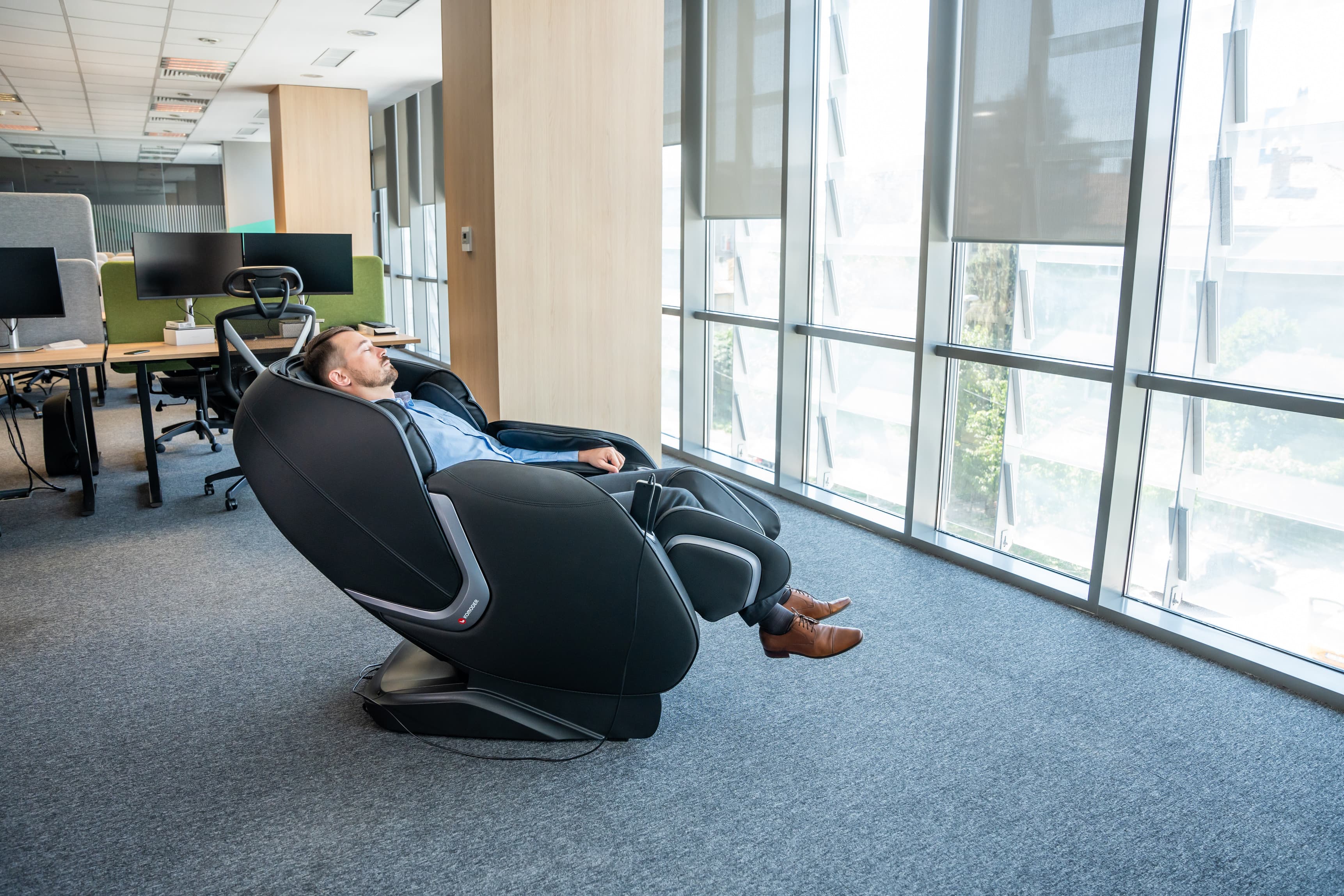
The idea of a work massage chair sounds perfect… and it can be, if it fits your routine. A gentle massage can help release tension in the shoulders and back after meetings, calls, or long focus sessions. The key is that the massage is adjustable and that you can use it without interrupting your workflow.
At Komoder, we usually recommend it in two scenarios: offices where people take planned breaks (2–3 rests per day), or spaces where the chair doesn’t replace the main work chair but works as a “recovery station.” If your priority is productivity at the keyboard, an ergonomic chair + a complementary relaxation space may suit you better.
- For breaks: back massage/air in legs + medium recline.
- For recovery: full programs, heat, and a strong footrest.
- For teams: ease of use and quick adjustments for different heights.
A good approach is to think of massage as part of your work break, not something that will stay on while you work with precision.
If you want premium rest in your office: why a Japanese chair changes the game
If your goal is to go from “I feel better” to “I truly recover,” Japanese massage chairs play in a different league. We’re not just talking about reclining: we’re talking about massage technology, structured programs, and sensations much closer to a professional massage, with an experience designed for well‑being.
In our experience at Komoder, when someone is looking for a chair for their office and brings real accumulated stress or tension, many times the smartest move is to create a relaxation corner with a serious massage chair and keep the work area with pure ergonomics. If you're interested in that path, you can explore our Japanese chairs and see what approach fits your routine.
5-minute routine: how to use reclining to perform better (without wasting time)
The ideal chair isn’t just the one you buy: it’s the one you use well. If your goal is to improve focus and reduce tension, try a simple routine at two moments of the day (mid‑morning and mid‑afternoon). It’s a very effective tip because it turns the chair into a habit, not a “I’ll use it someday.”
This routine works even without massage, just with posture and breathing. With massage, it's even more powerful, but it's not essential.
- Recline slightly and support your lower back well (1 minute).
- Relax shoulders, rest your arms and relax your jaw (1 minute).
- Breathe slowly: 4 seconds inhale, 6 exhale (2 minutes).
- Return to work mode by adjusting armrests and posture (1 minute).
What matters is repetition: with two breaks like this, many people notice less tension and a clear sense of sustained energy without extending the workday.
If you choose your reclining chair wisely —real use, controlled recline, lumbar support and useful footrest—, your office stops being just a place where you "endure" sitting and becomes a space where you work better and rest intelligently. And if you want to go one step further, integrating a massage chair as a recovery station can turn your daily routine into a wellness habit that you notice in your body and mind.